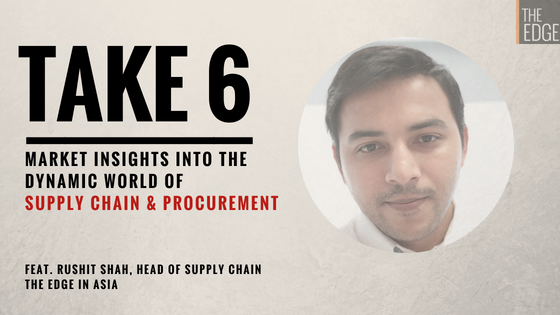
Take 6: Market Insights Into The Dynamic World of Supply Chain & Procurement
May 2018
May 2018
Rushit Shah, an Associate Director with The Edge who oversees the Supply Chain, Manufacturing, Procurement and Quality Management functions within multiple Industries in the Asia Pacific shares his top 6 takeaways on the biggest trends in the supply chain industry for 2018.
#1 When it comes to supply chain talent, what are the biggest trends in 2018?
That’s a good question. I normally divide core Supply Chain professionals into 2 categories.
1) Operational Professional
2) Strategic / Data-Driven Professionals
Both the categories will still have jobs in the future (or at least in the near future until robots take over the world) but the trend is to hire talents who are data-driven and who have strong data visualisation skillsets. One that is able to take decisions with past failures and successes in mind.
On the other hand, operational professionals will look for opportunities, which will impact the business in the short-term and they will continue the struggle for survival. The demand for these professionals is consistent and you will not see major hiring this year. This does not mean they are not valuable to the Supply Chain cycle in any organisation as without them there won’t be a future to improve or change.
Today, hiring managers are more conscious of hiring talents who are not strategic or data-driven as they want to ensure companies are not repeating their mistakes when it comes to investment in new supply chain transformation.
I wrote a post in the past about how more and more companies who have hired people to restructure the supply chain industry are now cutting cost by halting the transformation or making the transformation team redundant before they can execute what they started.
#2 Has the bar been raised for supply chain talents where they have to deal with new functions such as R&D, procurement, sales and operations planning?
Supply Chain as a whole has evolved so much in the last decade and also matured simultaneously. Apart from blockchain and digitalisation, I have not heard of other significant changes, although a focus on centralisation and cost cutting has been consistent.
#3 What keywords are recruiters on LinkedIn looking for in the supply chain industry?
Supply Chain is broken down into many sub-functions, and the most common ones are:
1) Supply chain
2) Supply planning
3) S&OP
4) Demand Planning
5) Distribution
6) Business integration
7) Site integration
And many more.
#4 Do most companies in Asia have a Supply Chain Leadership Development Programme in place to attract top talent?
Most companies do not have a Leadership Development Programme in place but having said that, there are many top companies who have a strong Leadership and Development programme as well as an Organisational Design programme. However, these are only a handful.
I am fortunate enough to work with clients who have a strong Supply Chain Leadership programme – often this means they have less needs to use people like me (recruiters) as they have strong pipelines of internal talent that rotate around the business functions.
External hiring is selective and extremely strategic. Many companies would have some form of a leadership programme, but it would not necessarily be supply chain focused.
#5 What’s the best way for a talent to network in 2018?
LinkedIn is the blockchain of networking. Aside from attending events relevant to your area, it is always a good idea to use LinkedIn as a way to get in touch with recruiters to help build out your network and contact base.
#6 What would you say are the top skills talents one should have in the supply chain industry?
Is it cliché to say that many top talents lack common sense? Many hiring managers often complain that they do not see common sense in young talent, in particular, when they try to complicate the supply chain industry. As it is, isn’t the supply chain not complicated enough?
However, we are beginning to see clients who are increasingly looking for technological expertise even for more traditional roles – for example, if you were in the supply planning space with coding capabilities, you would get snapped up by a variety of firms or industries.
To get the best talents in the supply chain industry, an option is to work closely with an experienced and innovative recruitment partner that is invested in and committed to the success of your supply chain.
Interested to learn how our team of Supply Chain & Operations Recruiters can help in finding leaders for your open positions? Feel free to reach out to Rushit or our team.

It raises a question that sits at the centre of where hiring is heading in 2026 — what…
Read More
Something a little counterintuitive is happening in recruitment: the tech that makes applying for jobs easier is also…
Read More
Why Q1 matters more than you think? January to March is one of the most strategic hiring windows…
Read More