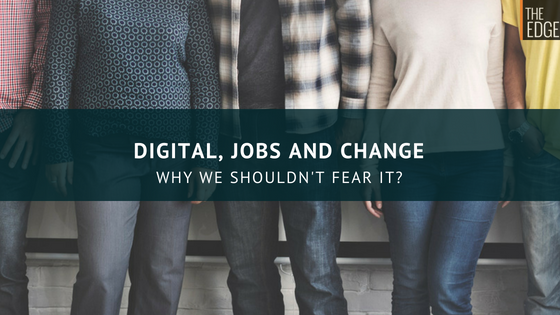
Digital, Jobs and Change: Why We Shouldn’t Fear It?
July 2018
July 2018
Imagine arriving at work one day and, to your surprise, your desktop/laptop is missing. What you get instead is a note that reads: “Your computer has been replaced with this smart device found in a compact package on your desk.”
Doubt, fear and questions like “how do I navigate around this?” ensues. The answer to the question and your qualms would be unknown – and panic would set in. This communication might fall short as there is no indication about expectations or benefits, just changes, which ought to be dealt with.
In reality, the above scenario may appear drastic but there’s a rapid change taking place as organisations are undergoing digital transformations which can be just as unsettling for employees.
In a recent study conducted by Workday and global market intelligence firm, IDC, titled ‘The Drive for the Digitally-enabled Workforce’, almost half (47%) of employees in Asia Pacific (APAC) see the rising digital economy as a threat to their job with 44% expressing lack of confidence in having the right skills to compete in the digital economy.
It was revealed that employees in Korea (62%) felt most at risk, followed by employees in Hong Kong (57%) and Singapore (50%). New Zealand (31%) and Australia (39%) felt the least at threat.
With this sort of uncertainty looming around, it’s time to take a proactive approach towards upskilling and finding new ways to put fear behind. Here are some tips to prepare for the changes ahead for both employees and organisations.
#1 Saying Yes to “Lifelong Learning”
There’s nothing better than having the attitude and will to experiment and learn new things. Fortunately, there is no lack of opportunity and availability when it comes to upskilling, and you don’t have to be held back if your employer isn’t interested in supporting your growth.
There are platforms such as LinkedIn Learning to establish connections with your employers or potential employers in order to learn from them. These courses offered by LinkedIn Learning prove beneficial in refining your general productivity, and they also concentrate on time management, and how to tackle your to-do list efficiently.
Courses in Udemy offer a great way to upskill in areas such as personal development, technical skills, and academics as well.
#2 Answer the question “What’s in it for me?”
The number one thing to put in place is a clear vision over time of what you want to be. “Why am I part of this digitalisation exercise?” “Is it because of the survival of the company I am working for? Or Is it because I want to change the way my customers interact?”
By answering this question, you will start to see the bigger picture and understand the external factors such as changing market forces and digital transformation that are needed in order to grow.
#4 Show them about the “Benefits” in the long run
As an organisation, it’s important to show how the new technologies that your company is adopting will benefit your organisation, ensuring that this is aligned to your business’ goals.
It also helps to make it clear on how your employees’ day-to-day work will be made easier. For instance, if you’re using big data analytics to improve your business efficiency – show how will this help an employee? Which of their activities will be streamlined or advanced, freeing up time to spend on more important tasks?
#4 Goes without saying: “Hire the right people”
It’s important to have people in your organisation who will champion all aspects of digital transformation and demonstrate how much easier it will make their lives.
A forward-thinking management requires a people-focused approach, so work closely with your counterparts in marketing, supply chain and senior leadership to ensure that your people strategy is as effective as your digital transformation strategy.
Do you need help hiring innovative employees or are you a talent looking for a change? Reach out to us at The Edge to find out about our specialist recruitment services.
It raises a question that sits at the centre of where hiring is heading in 2026 — what…
Read More
Something a little counterintuitive is happening in recruitment: the tech that makes applying for jobs easier is also…
Read More
Why Q1 matters more than you think? January to March is one of the most strategic hiring windows…
Read More