The Future of A.I. in HR
May 2018
May 2018
Authored by Shalini Parupudi, a Human Resources and Administration Consultant at Bangalore with The Edge Partnership. She is responsible for mid to senior level positions within BFSI, Technology, E-Commerce and Start-ups.
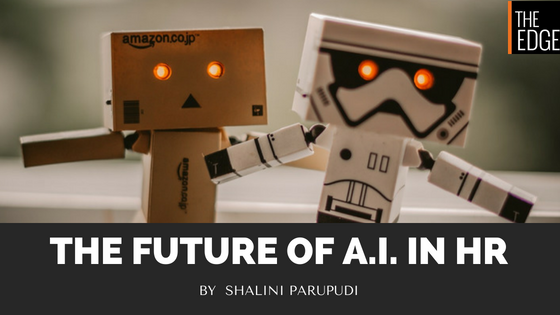
Thinking of Artificial Intelligence (AI) as a self-sustaining monster is a good concept for any dystopian fantasy fiction, but the fact stands that AI is nothing but human intelligence being mechanized. It can only repeat what it has been taught or what is stored in its database.
Any AI works on an algorithm and can outsmart the human brain in terms of understanding patterns, picking up on trends and making deductions based upon it, but what it can’t do is process information which comes above and beyond the fixed parameters. A human mind, on the other hand, can process the subtle nuances, emotional, psychological and circumstantial factors and improve upon AI’s deductions. So the mundane and repetitive tasks and time-consuming activities which have a fixed set of variables involved can be taken up by the AI, providing greater consistency and speed.
The time and energy thus saved can be used by the personnel in charge to focus on more human factors to make precise decisions. AI as chatbots or computer algorithms in the form of interactive software can easily aid HR Operations, Talent Acquisition and Talent management as an intelligent assistant to work smarter.
Decisions like whom to hire, whom to promote, who is in compliance, whose chances of retention are less, chances of sexual harassment, health and personal issues and other myriad of unending fact-backed variables get a better screening via AI before the HR professional can bring in her/his expertise and make a sound and profitable decision. Screening of resumes, reducing biases, promoting diversity, answering the general queries, scheduling and so on are a few aspects, which consume a lot of time and energy of professionals without utilizing their skill sets AI can take over these aspects of work, freeing the time of professionals to engage in more strategic analysis and decision making.
In Talent acquisition, AI can take over monotonous work from HR Managers by using multiple data sources to develop candidate profiles, scheduling interviews, providing basic screening questions that can eliminate a substantial amount of candidates, saving time, which would have produced no result. This allows the human counterpart to focus on more relevant HR issues, complex technical or philosophical inquiries, analysing and evaluating a smaller group of eligible candidates. This should help eliminate the cost of poor hiring decisions substantially.
AI can help the new talent with adaptation in the new environment. AI can be a personal guide for each position, which is humanly not possible and thus, a well-planned on-boarding program simulated by AI can increase retention rates. AI also can play a key role in employee training and professional skill development by planning, organising and coordinating such programs effectively for everyone, catering to specific individual needs.
In performance analysis, AI can monitor behaviour and analyse key performance indicators. HR managers can use this analysis to see if the recruits meet their set objectives. It can highlight the areas of strengths to cash in and zones of weaknesses to eliminate more precisely.
AI can track employee issues in real time and bring it to the notice of HR leaders, it can predict the needs and requirements of the employees which is a key factor in their retention. Performance analysis, personal needs and requirements, compensation and life-work balance analysis, all of it can help HR professionals to proactively solve the problems, diffusing any potential conflict point and thus, ascertaining employee retention.
Combining this intelligence with a machine only makes it a more efficient tool, not as a replacement for human skills but as an aid to take over the time consuming aspects, helping with the wider assimilation and processing of data to provide relevant analysis, trends and patterns which only further enhances the performance of the HR professionals in all departments, increasing the quality and quantity of the work.
It raises a question that sits at the centre of where hiring is heading in 2026 — what…
Read More
Something a little counterintuitive is happening in recruitment: the tech that makes applying for jobs easier is also…
Read More
Why Q1 matters more than you think? January to March is one of the most strategic hiring windows…
Read More